

Black Women Are Visible Long Before We Feel Safe
I have been thinking a lot lately about visibility and how differently it exists for Black women, especially first-generation Black women who were raised understanding that being seen and being safe were not always the same thing. I do not mean visibility in the shallow internet sense either. I mean the kind of visibility that begins long before you fully understand yourself. The kind where people are already forming opinions about you before you have even developed the language to explain who you are. I think many of us learned very early that attention could quickly become scrutiny, that self-expression could quickly become judgment, and that being visible often came with consequences we were expected to navigate quietly.
I was not the child teachers complained about for talking too much. Actually, it was the opposite. Teachers often told my mom I barely spoke. At first meeting me, people usually assumed I was shy, uninterested, intimidating, or simply did not like them. Looking back, I do not think I was naturally quiet as much as I was observant. There is a difference. Observation became protection for me. I learned how to read a room before I learned how to fully relax in one. I learned how to monitor energy shifts, facial expressions, tension, and tone before I learned how to openly reveal myself to people. There are still two versions of me people experience now. There is the observant version that watches first and speaks later, and there is the expressive version people often see online: loud, funny, opinionated, emotionally engaged, political, and deeply certain about what matters to me. For a long time, I thought those versions contradicted each other, but now I realize they were both survival skills shaped by the same reality.
I think first-generation Black girls are often taught awareness before authenticity. We learn professionalism before ease. We learn how to be digestible before we learn how to be free. There are so many unspoken rules attached to survival that nobody even says out loud because they become embedded into the way you move through the world. Read the room. Stay humble. Work twice as hard. Do not embarrass yourself or your family. Be respectable. Do not give people a reason. Do not make yourself a target. When you grow up internalizing those messages, you become hyperaware of how visible you are at all times. You start calculating how you are being perceived before you even decide whether you are comfortable. That hyperawareness does something to you over time. It teaches you that being understood is less important than being acceptable.
I think that is also why so many first-generation Black women struggle with maladaptive perfectionism. Research often describes maladaptive perfectionism as being rooted in fear of criticism, fear of rejection, shame avoidance, hypervigilance, and conditional self-worth. When I first started reading more deeply about it, I realized how much of it mirrors the emotional experiences many Black women are socialized into from childhood. We are taught that mistakes cost more. Failure feels more public. Being misunderstood feels threatening. So we overprepare. We overperform. We overextend. We become exceptional before we allow ourselves to become relaxed. We convince ourselves that if we are polished enough, educated enough, prepared enough, emotionally intelligent enough, then visibility will finally become safe.
But perfection has never actually protected Black women from scrutiny. It has never protected us from being misunderstood, criticized, politicized, copied, consumed, or underestimated. If anything, perfectionism often delays our ability to fully exist out loud because we keep trying to earn safety through performance first.
That realization has been sitting heavily with me lately because the life I want now requires visibility. Not just professional visibility, but personal visibility too. The work I want to do, the community I want to build, the impact I want to have, and the life I am creating all require me to be seen in ways that feel emotionally unfamiliar. There is a difference between existing quietly and intentionally allowing yourself to be witnessed. The internet has forced me to confront that. Not because I necessarily wanted attention, but because I wanted connection, impact, and expression. I wanted my thoughts to exist outside of private conversations and Notes app drafts. I wanted to create things that made people feel understood. I wanted to speak honestly about what it means to move through this world as a Black woman, therapist, creator, and first-generation person trying to build a meaningful life.
What nobody really discusses enough, though, is how visibility can feel like a loss before it feels like a gain. People romanticize growth constantly, but very few people talk honestly about the grief attached to becoming more visible. Visibility changes relationships. Sometimes it exposes envy. Sometimes it reveals emotional distance. Sometimes it shows you who only felt comfortable around your uncertainty, your silence, your insecurity, or your smallness. There is grief in realizing that some people preferred a quieter version of you because that version felt easier to control, easier to understand, or less confronting to their own fear of visibility.
I have felt that deeply lately. I have had people make comments like, “You really be talking on Instagram,” as though expression itself is embarrassing. As though visibility somehow cheapens depth. As though withholding yourself is inherently cooler or smarter than saying something real publicly. But honestly, I think a lot of people are terrified of being fully perceived. Being visible means people can disagree with you, misunderstand you, critique you, or project onto you. It means people can no longer create their own version of you in the absence of your voice. And for Black women especially, visibility often comes with the expectation that we remain emotionally useful while staying politically quiet.
That is impossible for me. I am a Black woman before I am any profession. Before therapist, creator, entrepreneur, or brand, I am still a Black woman existing in the same world everyone else is existing in. I do not stop being impacted by race, politics, misogyny, exhaustion, grief, or fear because I have a degree or clinical language for it. And in times like this especially, I have to center my Blackness before anything else because the world certainly does. That reality makes people uncomfortable, not because it is untrue, but because people often prefer Black women when we are inspirational without being disruptive. People enjoy authenticity until it begins challenging something in them. They love healing language when it remains aesthetic and digestible, but the moment Black women become visibly opinionated, politically vocal, emotionally layered, or fully human, people suddenly become uncomfortable.
I have also been thinking about this in relation to the conversations happening in the beauty industry right now around Painted by Esther and Patrick Ta. Watching that unfold felt familiar in a way I cannot fully explain because it reflects something Black women have experienced forever. Black women create culture constantly, but visibility also makes our creativity vulnerable to extraction. Innovation often becomes more respected once it passes through someone with more mainstream visibility, proximity to power, or broader acceptance. That pattern is older than social media itself. It is a tale as old as time. And I think that is part of why visibility feels emotionally complicated for so many Black women. It is not simply about being seen. It is about wondering what becomes vulnerable once people fully recognize your value. Visibility can bring opportunity, but it can also bring imitation, entitlement, criticism, and consumption.
That is why so many of us stay hidden until we are almost unbearably prepared. We are trying to outrun vulnerability. We are trying to perfect ourselves enough to survive visibility safely. But the truth is, Black women have always been visible. Hypervisible, even. Our labor is visible. Our survival is visible. Our strength is visible. Our bodies are visible. But our softness, interiority, complexity, grief, and humanity rarely receive the same level of care or protection.
I think that is what I am trying to unlearn now. The belief that safety only exists when I am smaller, quieter, less expressive, less political, less visible, or easier to consume. I do not think healing for me looks like disappearing better anymore. I think it looks like learning how to exist visibly without abandoning myself in the process. It looks like allowing myself to take up space without overexplaining my right to do so. It looks like understanding that visibility does not have to mean performance and that self-expression does not have to be earned through perfection first.
Maybe that is the real shift many first-generation Black women are trying to navigate right now. We spent so much of our lives mastering survival that visibility itself can feel emotionally unsafe, even when it is attached to our dreams. But maybe healing is not about becoming invisible again. Maybe it is about finally believing we deserve to be seen fully without shrinking ourselves to survive it.
Love y’all. K bye xoxox

Can Our Brains Handle This Much Fear?
Liberation psychology, collective panic, and what it means to stay human in a world that keeps asking us to brace ourselves.
My friends and I are probably going to get high and pick apart conspiracy theories. Honestly, that sounds like community care at this point. Not because we’re irresponsible. Not because we’re uninformed. But because what else are you supposed to do when every morning wakes up with a new threat? Another headline. Another disease. Another public health scare. Another act of violence. Another politician with a microphone saying something reckless about people’s bodies, minds, or right to exist.
A virus?
A boat?
Another war?
Now we’re talking about antidepressants like depression isn’t already chewing through communities that have been carrying too much for too long?
Baby, what is the plot?
Every day feels like a Boondocks episode somebody forgot to edit. What gets me isn’t even that it feels familiar, though it absolutely does. There’s a strange, haunting déjà vu in watching panic become part of our daily rhythm. It feels eerily like 2019, except this time many of us are entering it already exhausted. Already carrying grief. Already burnt out. Already bracing.
What gets me is what happens in my body. The moment I see Aaron Parnas pop up on my timeline, my nervous system responds before my mind has time to process what he’s saying.
My chest tightens.
My shoulders rise.
My jaw clenches.
My body says, here we go again.
That response is old. Older than me, in some ways. It is the body’s ancient intelligence trying to prepare for threat, trying to keep me safe, trying to predict pain before it arrives.
Fight. Flight. Freeze. Fawn. Hypervigilance. Somatic memory. Chronic activation.
I know this language intimately. I sit with clients every day and help name these experiences. My training is rooted in trauma, nervous system regulation, race, violence, systems, intergenerational survival, and the ways bodies carry what minds sometimes cannot hold. I understand, clinically, what chronic stress does to a person. I know that the body keeps the score.
But damn.
Knowing does not make you immune to feeling it. That’s been the humbling part. I can understand trauma and still feel overwhelmed. I can teach grounding skills and still find myself scrolling at midnight, looking for answers that aren’t there. I can know exactly what cortisol does to the body and still wake up tired in my bones. I can understand systems and still feel crushed beneath them.
That matters because somewhere along the way, we have become very good at pathologizing normal responses to abnormal conditions.
We ask:
Why am I so anxious? Why am I so tired? Why can’t I focus? Why do I feel numb? Why am I irritable? Why do I feel hopeless?
But maybe a better question is:
What am I responding to?
That question shifts everything.
Liberation psychologist Ignacio Martín-Baró argued that psychology cannot understand suffering by isolating it inside the individual while ignoring the social world that produces distress. In other words, sometimes what looks like pathology is actually an appropriate response to oppressive, violent, unstable conditions.
Read that again.
Sometimes distress is not dysfunction.
Sometimes it is awareness.
Sometimes it is grief.
Sometimes it is moral injury.
Sometimes it is a nervous system trying desperately to metabolize too much fear, too much uncertainty, too much instability, too much witnessing. And right now, we are witnessing too much.
Our brains were not built to consume every tragedy in real time. Every headline. Every threat. Every conspiracy theory. Every policy change. Every war update. Every economic fear. Every new thing to panic about before breakfast. We are saturated.
Emotionally saturated.
Psychologically saturated.
Spiritually saturated.
And for Black people, especially Black women, there is another layer that often goes unnamed: resilience has become expectation, and expectation has become burden. We are expected to carry history and still smile.
To be informed and still be hopeful.
To be politically conscious and still be soft.
To work, nurture, produce, care, organize, resist, heal, forgive, survive, and somehow remain beautiful while doing it.
That is an impossible ask of any human nervous system. That’s not resilience. That’s overload dressed up as strength. And I think many of us are quietly collapsing under the weight of what we have normalized. Not dramatic collapse. Not movie-scene collapse. The quieter kind.
Brain fog.
Chewed nails.
Fatigue that sleep doesn’t fix.
Emotional numbness.
Irritability.
Scrolling for hours.
Disconnection from joy.
A body that no longer remembers what relaxed feels like.
A spirit that feels thin.
That is not laziness. That is wear. That is cumulative stress. That is what happens when a body stays braced for too long. Truth is, there is no perfect coping skill for political unrest. There is no breathing exercise that undoes structural violence. There is no journal prompt that solves oppression. You cannot self-care your way out of systems that harm.
But you can protect what is sacred in you. You can refuse to let panic become your permanent address. You can keep some part of yourself untouched by constant access.
You can rest. You can laugh hard.
You can gather with your people. You can touch grass (well…. until we go on lockdown again…too soon?… sorry)
You can sit in sunlight. You can cry. You can dance. You can turn your phone off for a few hours without apologizing. You can remember that joy is not betrayal. You can remember that tenderness is not weakness. You can remember that protecting your mind is part of surviving.
And maybe that is where liberation begins, not just in resisting what harms us, but in reclaiming our humanity from what would consume it.
So I’m sitting with a few questions, and maybe you should too:
What fear is living in your body right now?
What news have you consumed that your nervous system has not yet processed?
Are you informed, or are you flooded?
When was the last time your body felt safe enough to fully exhale?
What does care look like when the world feels uncaring?
What does liberation feel like in your body?
I don’t have perfect answers. But I know you are not weak for feeling overwhelmed. You are not broken because your body is responding. You are not failing because you are tired. You are living through a lot.
We all are.
You are not carrying this alone. The world keeps asking us to brace ourselves. I am asking you, gently, to remember to soften too. Keep some of yourself for yourself. Your mind deserves refuge. Your body deserves peace where it can find it. And your humanity is still worth protecting.

Can I Trust My Soul?
I’ve been sitting with a question that I don’t think I can answer quickly. It’s not one of those questions that comes with a clear response or a neat conclusion. It’s the kind that follows you. That shows up in different moments. That changes shape depending on where you are and how honest you’re willing to be. Can I trust my soul?
Not my thoughts.
Not my plans.
Not the version of my life that makes sense when I say it out loud. My soul. I think for a long time, I believed trust meant certainty. That if I was truly aligned, everything would feel clear. There would be no hesitation. No second-guessing.
No moments of pause where I questioned myself.
But that hasn’t been my experience. What I’ve been experiencing feels different. Quieter.
There are moments where something feels right in my body before I can explain it. Not exciting. Not overwhelming. Just… settled.
Like a soft yes and every time I feel it, I notice the same pattern.I leave it. I go from feeling… to thinking. Is this the right decision? Does this make sense long term? How will this look? How do I explain this? Will this hold up if someone questions me?
And slowly, without even realizing it, I disconnect from the very thing that gave me the answer in the first place. I’ve been thinking about how often I do that. How quickly I override myself not because I don’t know but because I don’t fully trust what I know
unless I can translate it into something that makes sense to everyone else.
And I’m starting to realize that might be the thing that’s keeping me stuck. Some of the most important decisions in my life didn’t come with language they came with a feeling. A shift. A knowing.
And I followed it. And later, it made sense. But somewhere along the way, I started reversing that process. I started waiting for things to make sense first. Waiting until I could explain it.
Justify it. Lay it out in a way that felt structured and safe. I think I created distance between me and myself because my soul doesn’t speak in bullet points.
It doesn’t present arguments.
It doesn’t wait until everything is clear.
It just… knows.
And that knowing is quiet.
Which makes it easy to miss.
Especially in a life that is loud.
Because everything around us is asking us to think.
To plan.
To optimize.
To be strategic.
To make decisions that can be defended and I understand that there’s value in that, but I don’t think that’s the only way we’re meant to move through our lives.
Lately, I’ve been feeling the effects of living too far in my head. Burnout didn’t just make me tired it made me disconnected. Disconnected from my body and when you’re disconnected like that, everything starts to feel uncertain. Because you can’t hear yourself clearly anymore.
So I’ve been coming back slowly. I’ve been sitting outside more.
Not scrolling.
Not working.
Not turning it into content.
Just sitting.
Letting the sun hit my skin. Listening to the wind move through the trees. Feeling my body exist without needing to produce anything. At first, it felt… unfamiliar. I didn’t quite know what to do with that stillness but then something shifted. I started noticing things again.
My breath.
My thoughts slowing down.
The way my body actually feels when I’m not rushing it through the day and in those moments, I started to hear myself again. I realized something that I think I’ve always known, but never fully trusted. I don’t need more information. I need more connection because when I’m connected to myself, I don’t question every decision. I don’t over-explain everything. I don’t feel the need to justify what already feels right.
I move with enough trust to take the next step. And maybe that’s what trusting your soul actually looks like… trusting that something in you already knows enough to guide you forward.
So now I’m asking myself different questions.
Not:
“Does this make sense?”
But:
“Does this feel true?”
Not:
“Can I explain this?”
But:
“Can I stay with this?”
Not:
“What’s the outcome?”
But:
“What is this asking of me right now?”
I’ve been sitting with those questions instead of rushing to answer them because I think we move too fast sometimes. We feel something and immediately try to define it. Understand it. Turn it into a decision.
What if we… stayed with it? Let it unfold. Let it show us what it means
without forcing it into something we can explain. I know that’s not always easy because there’s a part of us that wants control.
That wants certainty and to know exactly where we’re going before we take a step. I don’t think life works like that. I think life meets you as you move. I think trusting yourself is less about knowing the destination and more about believing you can handle whatever you find along the way.
I’ve been giving myself time outside. Not as something I earn after being productive. But as something I need. The same way we track steps, the same way we commit to routines,
I’ve been asking myself:
What would it look like to be just as intentional about being present?
To actually let my body catch up to my life.
So here’s what I’m trying this week and maybe you can try it with me. Give yourself time outside. Not rushed. Not distracted. Just you. Sit somewhere. Walk slowly. Touch something real and while you’re there, don’t try to figure your life out.
Just listen.
Notice what comes up.
Notice what feels heavy.
Notice what feels clear.
And then ask yourself, gently:
What have I been overthinking that actually just needs my trust?
What feels right that I keep trying to make logical?
Where am I asking for proof when I already have a knowing?
What would it look like to move without explaining it first?
You don’t have to answer everything. You don’t have to make a decision right away.Just stay with yourself. That’s where trust begins. Not in having all the answers. But in being connected enough to hear them when they come.
I’m still learning. I’m still figuring it out but I do feel something shifting.
Less force. More listening. Less explaining. More trusting. If there’s anything I’m taking with me from this season, it’s, I don’t need to have it all figured outto start trusting the part of me
that already knows.
And maybe…
neither do you.
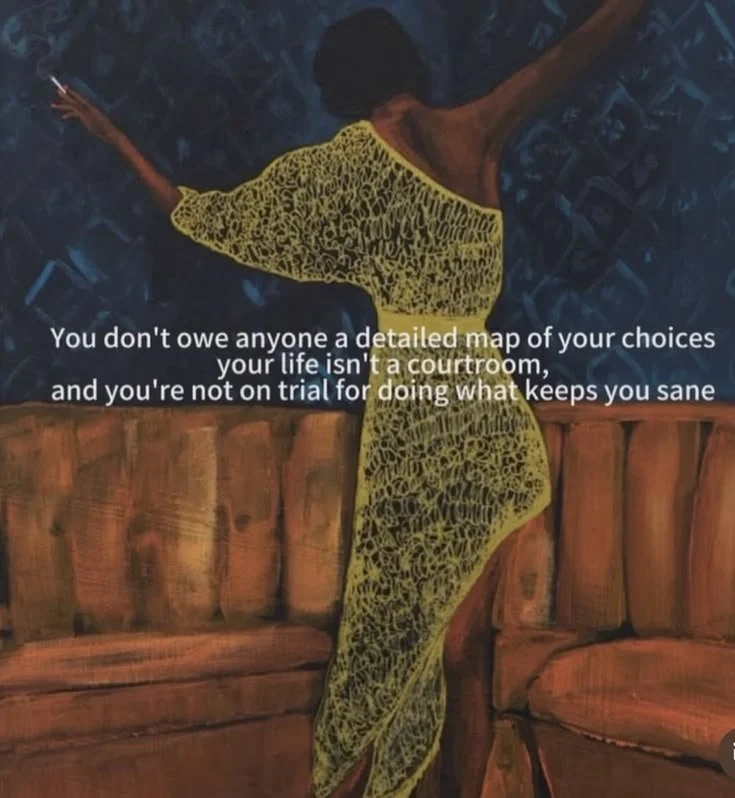
You Keep Explaining Yourself… But to Who?
I’ve been catching myself doing something I don’t love. And now that I’ve seen it, I can’t unsee it.
I keep explaining myself. Not just the big decisions. Everything. Why I’m doing something, why I’m not, why I changed my mind, why something that used to work for me doesn’t anymore. I’ll have a full internal monologue before I even move, like I’m preparing a statement.
For who?
Because let’s be honest, some of these explanations never even leave my mouth. They live in my head, fully formed and ready, just in case someone asks. Or worse, just in case someone judges.
And that’s when it hit me. I don’t think I’ve been confused. I think I’ve been waiting for permission.
Permission to change. Permission to pivot. Permission to not be the version of myself people recognize. Permission to choose something that doesn’t come with a clean explanation.
Because choosing something new is one thing. Standing on it without over-explaining it? That’s different.
And I don’t think I’ve been as comfortable with that as I thought.
Why do I feel the need to make everything make sense out loud? Why do I need a clear narrative before I can fully commit to a decision? Why does it feel safer to explain something than to just choose it?
I had to sit with that, and the answer wasn’t cute.
Sometimes it’s not about being understood. It’s about being validated. If I can explain it well enough, walk you through it, make it make sense to you, then maybe I don’t have to fully trust myself.
That part bothered me. Because I don’t want to build a life that only feels stable when other people agree with it.
And I think a lot of us are doing that, quietly. We’re not always asking for permission directly, but we’re shaping our decisions in ways that are easier to explain, easier to defend, easier to justify. And in the process, we delay things that already feel right.
I think a lot of us are living in the gap between what we know is right for us and what we can comfortably explain.
And that gap is where we start second-guessing decisions that were already clear. That’s where we overthink things that didn’t need that much thought. That’s where we shrink something that felt aligned into something that feels acceptable.
I’ve been living there. And it’s exhausting.
Some of the decisions I’ve been making lately don’t make perfect sense. Not on paper, not in conversation, not in a way that ties everything together nicely. But they feel right. Not loud. Not dramatic. Just calm in my body. Like I don’t have to convince myself.
When something is actually right for me, I don’t feel the urge to debate it. I feel the urge to protect it. So why am I still trying to explain it? When you start changing, you lose the comfort of being easily understood. People don’t always recognize you. Your decisions don’t line up with who you used to be. You don’t fit neatly into the roles people had you in.
And that can feel uncomfortable. Not because you’re doing something wrong, but because you’re no longer predictable.
And predictability is comfortable for other people.
But comfort for them doesn’t always mean alignment for you.
How Do You Get Out of the Gap?
You don’t jump out of it overnight.
If you’ve been living in that space where you know what’s right but feel like you need to explain it that’s a habit.
A pattern.
A safety mechanism.
So the goal isn’t to suddenly become someone who never explains anything.
The goal is to start loosening your dependence on being understood.
1. Catch yourself in the moment
Before you change anything, you have to notice it.
Pay attention to:
when you start over-explaining
when you rehearse conversations in your head
when you feel that urge to “make it make sense” for someone else
That moment is the gap and instead of immediately going into explanation mode, pause.
Ask yourself:
“Who am I explaining this for right now?”
Not in a judgmental way but curious way.
2. Practice saying less
This may get uncomfortable. You don’t have to go silent overnight. Say the decision… without the full breakdown.
Instead of:
“I’m doing this because XYZ and I’ve been thinking about it for a while and…”
Try:
“I decided this is what’s best for me right now.”
And then… stop talking. Let it sit. You’re going to feel the urge to fill the silence.
3. Let people not get it
This is where most people tap out because it’s not actually the explaining that’s hard…
it’s the possibility that someone will:
question you
misunderstand you
not agree
And you’ll have to sit there and not fix it. That’s the practice. People can misunderstand you and you can still be right for yourself.
4. Build evidence with small decisions
You don’t start with life-altering moves. Start small. Make a decision that feels right…
don’t over-explain it…and watch what happens. Nothing falls apart. That’s how trust is built. Not through affirmations…through lived proof.
5. Get comfortable not having the perfect words
Some decisions won’t come with a clean explanation. And that’s okay. You’re allowed to say:
“I don’t fully have the language for it yet, but I know it’s right for me.”
That’s growth. Not everything has to sound polished to be valid.
6. Check your body, not the audience
You’ve been checking the room:
“Does this make sense to them?”
“Do they agree?”
“Is this landing well?”
Shift it.
Start checking:
“Do I feel settled in this?”
“Do I feel like I’m forcing this?”
“Do I feel like I’m trying to convince myself?”
Your body will tell you faster than your explanations ever will.
You don’t get out of the gap by becoming more confident overnight.
You get out of it by:
tolerating discomfort
making decisions anyway
and not running back to over-explaining to soothe yourself
Some of the most aligned decisions you’ll ever make won’t come with a perfect explanation. They come with a feeling. A knowing. A quiet certainty that doesn’t need a paragraph.
And if you’re not careful, you’ll talk yourself out of it just because you can’t package it neatly enough for other people.
I don’t want to do that anymore. I don’t want to wait until I can explain my life before I live it. I don’t want to shrink my decisions into something more digestible. I don’t want to keep rehearsing my choices like I’m presenting them for approval.
I just want to choose.
And trust that I’ll understand it more clearly as I go. That’s what I’m practicing right now. Not perfection. Not certainty. Just movement. Without over-explaining it. And if I’m being honest, it feels uncomfortable. But it also feels like freedom.
So if you’ve been feeling stuck lately, not because you don’t know what to do, but because you don’t know how to explain it, you don’t need a better explanation. You might just need permission and if nobody’s given it to you yet, give it to yourself.
Here’s some journal prompts I’ve sat with on this topic:
What decisions in your life feel clear to you… but hard to explain to other people?
Who are you trying to convince when you over-explain your choices?
If nobody asked you to justify your life, what would you choose next?
What already feels right that you keep second-guessing?
Do you actually need clarity… or do you need permission?
At some point, you’re going to have to decide if you trust your voice more than you trust being understood.
And I think I’m finally getting there.
Trauma and the Brain (Or: What Are We Doing Here?)
When I was younger, I loved Pinky and the Brain. Like… obsessed. I still watch old episodes to this day and laugh like I haven’t already memorized the script. Something about Brain waking up every single day like, “The same thing we do every night, Pinky…” with full confidence knowing good and well it didn’t work yesterday really used to take me out.
Looking back, I think that show shaped my interest in the brain. Because if you really think about it… that’s the brain. Same patterns. Same loops. Same attempts to make sense of things, over and over again. And sometimes… the plan doesn’t work. But your brain? She’s still going to try.
In my last post, I talked about burnout. Not the cute kind. Not the “I need a spa day” kind. The kind where you’re sleeping too much but still tired, eating your way through your pantry, calling off work, irritable, off your routine in a way that makes you look at yourself like, “Now hold on… what’s going on?” And then having a professional confirm it someone telling you something you literally tell your clients Monday through Friday and you sitting there like, “Oh… so we doing this for real?”
And to be so real, I felt a little shame. Because in my head I’m like, girl… you know better. But that “you should have known better” voice? That voice is loud. And it is also wrong. Because knowing something and living it are two completely different things.
And that’s where trauma comes in. Because trauma doesn’t just sit in your past like a memory you can pull out when it’s convenient. It lives in your body. In your reactions. In your habits. In the way your brain tries to protect you before you even realize you need protection.
Trauma can inform you, but it does not get to control you.
That’s the difference I’ve been sitting with lately. Because a lot of us think healing means getting to a place where nothing affects us anymore. Where we’re calm, regulated, unbothered no matter what’s happening around us. That’s not real. Especially not right now.
Because the world? The world is doing a lot. Every day feels like a Boondocks episode that didn’t need a second draft. Like somebody hit “publish” on chaos and just let it ride. And part of me is like… what the hell is actually happening? And the other part of me is like… 93% of us told y’all. But anyway.
We are human. We are going to feel what is happening around us. Fear. Frustration. Anger. Confusion. That doesn’t mean something is wrong with you. That means your brain is doing exactly what it was designed to do take in information and try to keep you safe.
But here’s where it gets tricky. If you don’t understand what your brain has learned from trauma, you will think your reactions are just “who you are.” You’ll tell yourself, I’m just anxious, I’m just sensitive, I’m just overthinking, when really your brain is responding based on patterns it built to survive.
And then you add burnout on top of that. Now your brain is tired. Your body is tired. Your coping skills are stretched thin. So everything feels louder. Everything feels heavier. Everything feels like it might be too much. And instead of saying, “I’ve been carrying a lot,” we say, “What’s wrong with me?”
Nothing is wrong with you. You are responding to a lot of input.
Trauma informs you. It tells you, this is familiar, this is not safe, pay attention. And sometimes it’s right. But sometimes… it’s responding to something that is not actually happening in the present moment.
That’s why I keep coming back to mindfulness. Not in a “sit still and be perfect” kind of way, but in a “where am I right now?” kind of way. Being where my feet are planted. Not where my anxiety is trying to take me. Not where my past has already been. Not where the world might go next week. But here. Now.
Because if I let everything I’ve experienced and everything that’s happening right now take over… I will lose myself in it.
So I’ve been practicing something simple. Not easy. But simple. Noticing. When I’m overwhelmed. When I’m irritable. When I’m reaching for food, sleep, distraction, anything to quiet the noise. Not judging it. Just noticing it.
And then asking myself: what do I actually need right now?
Sometimes the answer is rest. Sometimes it’s turning the news off. Sometimes it’s laughing at something stupid. Sometimes it’s texting a friend. Sometimes it’s just saying, “This is a lot… and I’m doing my best.”
Because healing is not becoming someone who never reacts. It’s becoming someone who understands their reactions.
Trauma can inform you, but it does not get to control you.
And right now, that looks like letting myself feel what’s real without letting it take over everything. Letting the world be what it is without letting it define my entire internal state. Trusting that I can move through this without abandoning myself in the process.
I’m still tired. I’m still coming out of burnout (ish, ya girl is in the deeps of it). I’m still figuring it out. But I trust myself a little more now. To notice. To pause. To choose differently when I can.
And in a world that feels like it’s doing entirely too much… I think that’s enough.
If you’ve been feeling off lately not broken, not dramatic, just… off this might be part of it. So take a second. Check in with yourself. Not who you think you should be, but who you actually are right now.
And meet her there.

Girl… You Might Be Burnt Out
I didn’t think I was burnt out. I just thought I was having a week.
You know the kind.
Where everything feels slightly off, but not enough to call it a breakdown.
Just enough to make you feel like you’re moving through your life a little… disconnected.
I was sleeping more. Not the kind of sleep that restores you. The kind that feels like hiding.
I was eating my way through my pantry.
Not because I was hungry like that, but because I needed something. Something comforting. Something consistent.
I was calling off work. Irritable. Off my routine in a way that didn’t feel like me.
And if you know me, you know my routine is my anchor. It’s how I stay grounded. It’s how I come back to myself.
So when that started slipping, I should’ve known.
But burnout is quiet. It doesn’t always announce itself. It just slowly pulls you out of yourself until one day you look up and think,
“Why don’t I feel like me anymore?”
What really humbled me was having someone else name it. Another professional.
Sitting on the other end of the call, explaining something I talk to my clients about Monday through Friday.
And I just sat there like, “Oh… well that makes sense.” And then, almost immediately, I felt it.
Shame.
Because in my head I was like, Girl… you know better. But that “you should have known better” voice? It’s loud… and it’s wrong. “Should have” language is wild in moments like this. Because it assumes that awareness automatically equals protection. And it doesn’t.
The truth is, I invest a lot into myself. My habits matter to me. My routines matter to me. The way I show up for myself and for others matters to me.
So yeah, it sucks to be here. It’s frustrating to realize that even with all of that intention, all of that effort, I still hit a point where my body said, “We’re done for now.” And I had to listen. Because sometimes life will sit you down. Not because you failed. But because something needs to change.
And I have to say this…. especially for us. Because I see it all the time. It’s researched. It’s documented. It’s real. Burnout looks different in us.
We don’t always stop. We don’t always collapse. We keep going. We show up. We handle it. And because we’re still functioning… we convince ourselves we’re fine.
But functioning and being well are not the same thing. And then life keeps happening on top of it.
The bills.
The work.
The responsibilities.
The world… which, let’s be honest, feels like it’s doing entirely too much right now.
Every day feels like a Boondocks episode that went a little too far. Part of me is scared. And the other part of me is like…I’m Black. I have never known a life that didn’t require resilience.
This world was built by people who look like me, but not always built with my ease in mind. And still we’ve survived every version of it. There’s something in that.
Something grounding.
Something ancestral.
Like somewhere in my body, there’s a quiet knowing that says: You’ve done this before. You’ll get through this too. So now I’m not trying to rush out of this. I’m not trying to fix it overnight. I’m not trying to force myself back into who I was last week.
I’m just… coming back to myself. Slowly.
I’m checking back in with my mindfulness. With my breath. With my body. I’m practicing being where my feet are planted. Accepting what is,
without immediately trying to change it. Trusting what’s coming,
without trying to control it. And most importantly trusting myself to move through this in a way that actually nurtures my mind and my body.
If you’ve been feeling off… tired in a way that rest doesn’t quite fix… till showing up but not fully there… This might not just be a bad week. You might be burnt out. And that doesn’t make you weak. It means you’ve been carrying a lot for a long time. So tonight…we’re not fixing everything. We’re not catching up on everything we fell behind on. We’re not forcing ourselves back into routine like nothing happened. We’re resting where we can.Doing what we can. Letting that be enough.
Because if burnout takes time to build…it’s going to take time to heal. And we deserve that time.
Missed y’all xoxox
Your Brain Is Built for Change: On Neuroplasticity, Healing, and Choosing Yourself Anyway
Back in undergrad, I thought I’d end up a neurosurgeon. I was knee-deep in neuroscience and psychology courses, learning anatomy, memorizing the limbic system like it was gospel. I used to imagine myself in scrubs, steady hands, life in my palms.
But here I am years later no scalpel, just stories. Still obsessed with the same organ. Still studying the most resilient muscle we’ve got: the brain.
It’s funny how that obsession has come full circle. Because now, in therapy sessions and in my own life, I get to witness what the textbooks couldn’t capture, how the brain rewires itself through love, loss, rest, joy, and everything in between. The science calls it neuroplasticity. I call it proof that you won’t always feel this way.
The Brain’s Favorite Hobby: Adapting
Neuroplasticity is the brain’s ability to change, to create new neural pathways, strengthen or prune old ones, and reorganize itself after stress, trauma, or learning. In plain language? It means nothing about you is fixed. Not your habits, not your fears, not the version of you that thought the pain would never stop.
Your brain is an architect constantly remodeling based on what you feed it. Every moment you choose presence over panic, compassion over criticism, or curiosity over control, you’re laying down new wiring.
And that’s the quiet miracle most of us forget: our brains are healing, even when we aren’t paying attention.
Winter Blues and the Brain’s Weather System
Lately, it feels like everyone I know is tired. The sun sets too early. The news cycle is relentless. We’re overstimulated and under-rested. The world feels heavy and so do our nervous systems.
Seasonal Affective Disorder, or just plain winter blues, isn’t just emotional. It’s neurological. Less sunlight means lower serotonin, disrupted circadian rhythms, and a body that can’t quite tell the difference between slowing down and shutting down.
But if neuroplasticity has taught me anything, it’s that the brain can learn to find light in other ways. You can build a rhythm of self-compassion even in the dark. Light a candle, stretch your body, take a walk during lunch each act becomes a message to your brain: I’m still here. We’re still moving.
We can’t skip winter, but we can remind our bodies that spring is inevitable.
Issa, Olivia, and the Art of Staying Soft
Whenever I think about growth in real time, I think about Insecure’s Issa Dee. How her world fell apart and reassembled in ways she didn’t expect friendships strained, love got complicated, career shifted but she kept choosing herself through it all. There’s that quiet scene where she’s just in her mirror again, hyping herself up, not because she’s got it all figured out, but because she’s trying.
That’s what healing looks like: staying grounded in your routines and rituals even when chaos is loud. Issa’s mirror monologues were her nervous system regulation in disguise. They were self-talk, embodiment, grounding the rituals that told her brain, We’re safe. We can keep going.
And lately, I’ve been looping Olivia Dean’s new album because she captures that same emotional evolution. She sings about healing not as a destination but as a practice. The songs feel like the sonic version of neuroplasticity love lost, boundaries formed, softness learned. There’s something powerful about listening to music that mirrors your brain’s own process of rewiring. You start to realize that you’ve changed too.
Repetition Over Resolution
Our culture loves the idea of a breakthrough that one therapy session, one journal entry, one yoga class that changes everything. But the brain doesn’t heal in a single revelation. It heals through repetition.
Think of it like a dirt path: the more often you walk it, the clearer it becomes. That’s how new neural pathways work. Every time you practice a different response like taking a breath instead of shutting down, reaching out instead of isolating, saying “I don’t have to fix this right now” you’re deepening that path.
That’s why routines matter. Not because they make you productive, but because they make you safe. Your brain craves predictability; it helps regulate your nervous system and widens your window of tolerance, that sweet spot where you can handle life without becoming numb or overwhelmed.
So when you find yourself melting down over small things this winter, pause and ask: Am I outside my window right now? Maybe you don’t need to push through it. Maybe you just need to come back to center — breathe, ground, name what’s happening.
That’s not weakness. That’s neuroscience.
The RAIN of Self-Compassion
When I talk to clients about emotional regulation, one of my favorite tools is RAIN, coined by Tara Brach. It’s a mindfulness skill, but honestly, it’s neuroplasticity in action. It retrains your brain to meet discomfort with kindness instead of shame.
Recognize what’s happening — name the feeling without judgment. (“This is sadness. This is anxiety.”)
Allow it to be there — no fixing, no rushing.
Investigate what it needs — curiosity instead of criticism. (“What might this feeling be trying to tell me?”)
Nurture yourself through it — a hand over your heart, a kind word, a deep breath.
Every time you do this, you teach your brain that feelings aren’t threats; they’re information. You expand your capacity to feel without losing yourself in it. Over time, that becomes your new baseline a softer, steadier way of being.
Change Is the Brain’s Love Language
We’re all walking around carrying old stories that we’ll always be anxious, always attract chaos, always feel behind. But if the brain is designed for anything, it’s adaptation.
Your neural wiring from five years ago is not the same as today. Your mind has weathered grief, built new joy, survived heartbreaks, learned boundaries, created safety where none existed. That’s not coincidence that’s rewiring.
So when you catch yourself saying, “I’ll always be this way,” pause. That’s an outdated file. Your brain has already updated the software you just haven’t noticed yet.
You Won’t Always Feel This Way
Maybe you’re in your Issa era trying to build peace in the middle of mess. Maybe you’re in your Olivia Dean season learning that healing doesn’t always sound pretty, but it’s real. Maybe you’re just trying to survive another gray Chicago winter (same).
Wherever you are, remember this: your brain is working for you. Even in exhaustion, even in fear, even when it feels like nothing’s changing your neurons are quietly doing their thing, creating new pathways toward ease.
You won’t always feel this way. The sadness will shift. The anxiety will soften. The light will come back inside and out. That’s not just hope. That’s science.
If you’ve been feeling stuck or heavy lately, try this:
Tonight, sit with yourself for two minutes. Put your hand on your chest. Take one slow breath and say, I’m changing, even if I can’t see it yet.
That’s it. That’s the work.
Your most resilient muscle is already doing the rest.

I Could Cry, But I Could Also DoorDash Sushi
I am not coming to you today with a think piece.
No deep framework.
No “5 lessons I learned.”
I just… wanted to kick it with y’all. I’m currently writing this at 2:32 AM on a Friday. Because this week has been a week.
You know when life starts piling up quietly? Like one second everything is under control and the next second it looks like the house, the dog, the bills, your job, your hair, AND your internal emotional world all clocked in to jump you at once?
Yeah. That was me this week. I realized it had gotten bad when I looked down and I had chewed three of my nails completely off.
Not one.
Not two.
Three.
My nails always tell on me before I speak. If they’re raggedy, just know my brain is pacing back and forth inside like, “We are not okay, but we are going to pretend we are because we have things to do.”
The house was house-ing.
Meaning: chaos.
Laundry looking like a sculpture installation. Dishes forming community. (LMFAAAOOO that was a good one). Work assignments politely waiting in the corner like, “Sooo… you remember us?”
And on top of that — my dramatic shih tzu was acting like she was auditioning for an Oscar in the “my tummy hurts please rush me to the vet AGAIN” category. The vet bill almost knocked the wind out my chest.
Just a regular Wednesday.
The World Feels Like It’s Ending, Too???
And while all this is going on in my little corner, the world at large is also… doing whatever this is. Every day feels like a Boondocks episode written by someone who is tired and has had enough.
Part of me is scared.
And the other part of me is like… I’m Black. This world was built by me but not for me. I don’t know this life without resilience.
On a cellular, ancestor level, we’ve seen some things.
And somehow, we are still here.
It’s wild to realize my body already knows how to survive a world that doesn’t even try to deserve me.
There’s a strength in that.
A softness too.
So yeah the world may be glitching.
But I’m gonna survive…. I think….
The Midnight Sushi Salvation
Anyway.
Sometime around 11:47 PM Friday I hit my limit.
I didn’t cry… today….
Didn’t spiral.
Didn’t start catastrophizing the next 40 years of my life (progress!).
I… ordered sushi.
Like a grown woman who knows emotional first aid.
Shoutout to Jieyi Sushi and the delivery driver who brought not just food but stability, grounding, and hope.
Tell me hamachi isn’t a coping skill.
I sat on TikTok [watch here], eating salmon sashimi with my dog staring at me like she was the one paying the grubhub fee.
The Tiny Joys That Pulled Me Back
I’m getting my nails fixed in a few hours.
I’ve had conditioner in my hair all day, is that safe? I’m getting braids this weekend so lets warn the streets—- y’all know what that means.
Writing this I’m reflecting on how things feel… manageable. Not fixed. Not solved. But softer.
Sometimes healing is not a big moment.
Sometimes it is micro-doses of joy:
Midnight sushi
A fresh set
Warm water running through your coils
Folding one corner of one room
Your dog finally going to sleep
A deep sigh that loosens your shoulders
That’s living.
Comfort Shows = Emotional CPR
And when my brain is tired of being a person, I return to my comfort shows.
Insecure. Girlfriends. Sex and the City. Living Single.
Shows where women are figuring themselves out in real time and somehow still laughing.
Watching Issa talk to herself in the mirror always reminds me I’m not the first to feel like life is a little ridiculous.
Comfort shows are not “lazy.” They are emotional grounding.They remind you who you are when life is too loud.
I Didn’t Die.
That’s the check-in. Not a triumph story. Not a breakdown story. Just proof that stress didn’t take me out.
My world did not end because I had a rough week. My life didn’t fall apart because I fell behind. I didn’t lose myself I just… lived through it. Messy, tired, hungry, overwhelmed but still me. Still becoming. Still here.
Maybe you also had a week. Maybe your nails told your business too.Maybe your laundry is calling your name. Maybe you feel like the world is ending on multiple fronts. Listen. You are not failing. You are just alive. And being alive is ridiculous.
So tonight?
Order the sushi. Deep condition your hair. Turn on your comfort show. Breathe. Laugh. Don’t over-explain your feelings.We’re all just figuring it out. And we’re doing it. One sat a time.

Becoming Who You Asked For
Good is scary.
And I mean that with my whole chest.
When you’ve spent most of your life waiting for the next shoe to drop, peace starts to sound like the calm before the storm. You finally get the job, the apartment, the relationship, the therapy breakthroughs and your first thought is, “Okay…but what’s the catch?”
I used to think I was scared of failing.
Turns out, I was scared of arriving.
Because once you finally get what you prayed for, what do you even do with it? When your whole identity has been built around striving, healing, fixing, surviving what happens when things actually get… good?
It’s weird. You beg for peace, and when it shows up, you start pacing like, “Do I even deserve to rest?”
Defining Good for Myself
Sometimes I sit and ask myself, What does good even mean for me?
Not how it looks online. Not the aesthetics. But what does “good” feel like for my actual experience?
Because I think we talk a lot about wanting “better,” but we never define it. We just chase it. And when it shows up, we don’t recognize it because we’re still scanning for problems.
Maybe that’s why good feels so unfamiliar it asks us to stop hustling and start receiving.
Now Let Me Put Y’all in My Business
So, Sunday night. I’m walking my dog, feeling grounded, enjoying the fall air in Chicago and then boom.
A boot on my car.
I froze. I just stood there like, surely this is a prank.
Now let me say this: I’m a responsible woman. I don’t play with them people about their money. But I moved back to the city this summer, still haven’t changed my address (ahhh I thought this was a safe space. I haven’t had my middle part buss down all summer and I need that for my ID picture—the girls who get it, get it), and apparently I collected a few camera tickets I didn’t know about.
When I tell you the City of Chicago does not miss…
$673. How g?!!?!
Now, the old me would’ve lost it. Tears, panic, end-of-the-world energy. Even if I had the money, I’d still crumble just off principle.
But this version of me? I looked at that boot, took a breath, and said, “chile….” Then I went inside, logged in, and paid it.
Did I tear up pressing “submit”? Absolutely. Inflation is violent.
But did it ruin my day? Not even close.
Because inconvenience isn’t the end of the world anymore.
A Small, Grown-Woman Win
That was my little reminder that I’ve become the version of me I used to pray for.
Not the perfect, everything-figured-out version but the woman who can handle life without falling apart every five minutes.
Growth used to mean “nothing bad ever happens.”
Now it means “I know what to do when it does” and in the event I don’t know “I will figure something out.”
That’s the quiet kind of flex nobody talks about the kind where your peace doesn’t depend on everything going right.
When Life Keeps Life-ing
Even when you reach good, life doesn’t stop.
The emails still flood in. The tickets still appear. Somebody still tries you on a Tuesday.
The difference is you.
Now, I breathe before reacting. I pause before spiraling. I laugh at things that used to make me cry.
That’s what growth looks like for me—steady, not stoic.
Learning to Let the Good Stay
I’m learning that “good” doesn’t mean everything’s perfect it means I can stay grounded even when things aren’t.
It’s walking my dog after paying $673 and still feeling thankful I could pay it.
It’s realizing the version of me that used to be triggered by every inconvenience has been replaced by someone softer, wiser, and honestly, funny as hell about it.
Good still feels scary sometimes, but that’s just the growing pains of peace. It’s what happens when your nervous system is learning that calm is safe, too.
If You’re Reading This…
Maybe you’re there right now sitting in the middle of something you once prayed for and not even realizing it because you’re already onto the next goal.
Pause for a second.
Look around.
You might already be living parts of the life you used to beg for.
And if that’s true, celebrate it. Even if your car just got booted. Even if your hair isn’t quite done yet. Even if you’re still figuring out what’s next.
Because this? This is becoming.
Not perfect. Not finished. But present.
I’m not done growing, but I can say this:
This version of me, the one who handles her business, cracks jokes through chaos, and trusts the process, is someone I used to only imagine.
And that’s worth a little gratitude.
And maybe… finally changing my address.
The Return: What a Pause Taught Me About Rest, Clarity, and Creating Again
It’s been a lot going on.
This summer, I finally gave myself permission to just be. No overthinking content calendars, no chasing a new version of myself, no “what’s next?” Just presence. And honestly? It changed everything.
I moved back into the city after a breakup that somehow turned into us falling back in love (that story is gonna be a crazy one to tell one day). I saw Beyoncé and was revived. I spent real time with my sister the kind where you talk for hours and realize how much you’ve both grown. I threw a workshop for my company, quit my job, transitioned fully into a private practice, and somehow ended up with a waitlist.
I grieved. I healed. I traveled. I lost 20 pounds and reconnected with my body in a way I hadn’t before. I turned 30, a milestone that feels both grounding and freeing. I built a steady TikTok following, paid off some student loans and debt (and yes, probably accumulated a little more, because life has range). Chicago has been making me proud lately, and while this country still has me exhausted I’m finding joy, softness, and grounding in my corner of it.
The Silence Between Seasons
Somewhere in between all of that living, I went quiet.
Not because I ran out of things to say, but because I needed to live the things I wanted to talk about.
I needed to rest without proving I deserved it.
To stop producing and start listening to myself, my people, my spirit.
And in that quiet, I realized something: I get spooked when things get good.
When life starts aligning, when opportunities come, when people actually listen to me it scares me. I pull back. It’s like some part of me still braces for the fall, even when I’m standing in the middle of something beautiful.
I don’t know if you’ve ever felt that way when things start feeling too good, too safe, too stable, and your brain says, “this can’t last.”
But I get it. It’s scary to be heard. To be seen. To know your words, your work, your presence actually land.
And even though I understand where that fear comes from, I’m learning not to let it dictate how I show up anymore.
Learning to Water the Now
Right now, I’m in a spot where things feel like they’re getting really good. Not perfect but aligned. I’m rearranging relationships, paying attention to who and what makes me feel good, and letting go of what drains me.
I’m open to new opportunities, and I’m nurturing what’s already here friendships, work, love, and the version of myself that’s evolving quietly behind the scenes. More than ever, I’m living in the present.
One of my clients shared something recently that stuck with me she chooses a word every birthday to guide her year. And honestly, I think I’m borrowing that. I don’t have my word yet, but I know it’s rooted in presence. In watering what is.
I’m no longer chasing how good it could get. I’m focused on how beautiful it already is.
At this point in my life — at 30 — I’ve seen enough to know that things fall apart sometimes. And not every ending has to mean something bad.
Sometimes things fall so they can grow back sturdier, softer, more intentional.
I have no doubt it’ll be good one day. But for now, I’m tending to what I know, what I feel, and what’s right in front of me.
Coming Back, Differently
This isn’t the kind of return that’s about catching up it’s about realignment. I’m not here to chase algorithms or force vulnerability into a caption. I’m here to speak from the soil of what I’ve lived.
Because the truth is, consistency doesn’t always look like posting every week. Sometimes it’s showing up to your own life first. Sometimes it’s trusting that your voice still matters even when it’s been quiet.
So here I am rested, rearranged, and re-inspired.
Ready to create again.
Not from pressure, but from peace.
And if you’ve been in your own quiet season, I see you. Don’t rush out of it. The world will still be here when you come back and you might just return clearer, softer, and more you than before.
No Blueprint, No Problem: Healing and Breaking Through Doubt
It’s finally here! I’m beyond excited to officially announce Healing Spaces: Wellness for Marginalized Communities—a one-day event that’s been in the making for some time. This isn’t just another wellness gathering—it’s a space for Black, Brown, and marginalized communities to heal together. We’ll be offering somatic healing workshops, aromatherapy, panel discussions on trauma and resilience, and a community-focused mixer where professionals and participants can connect. Tickets officially go live on April 1st, and I couldn’t be more thrilled to invite you to join us on June 14, 2025, for this transformative day of healing.
Tickets and event details are available here :)
Let me keep it a buck— it was never an option for this event to not happen. By now, y’all should know me a bit, and to know me is to know—if I don’t got anything, I have audacity. The idea of letting self-doubt or fear stop me from making this happen? Not even on the table. Not an option. Not even for a second did I consider quitting, letting self-doubt take the wheel, or listening to the voice that says, "Maybe you’re not cut out for this." But if I had bought into those stuck points, if I had allowed those thoughts to control me, maybe it would’ve been. Maybe I wouldn’t be here today, inviting you to join me for what will be a powerful and liberating experience.
I don’t buy into those stuck points. And neither should you.
I’m really just a girl from Englewood, grew up low-income, experienced some things that really messed with my mind. I’ve been through enough to make anyone second guess their worth, their dreams, their potential. But every time that voice—whether it’s internal or external—pops up telling me I’m not enough or that my dreams are too big for me, I remind myself: being a Black woman means I’m raw as shit. Directions? Never had them and I don’t need them.
I don’t need to follow anyone’s map or mold. I’m carving my own path, and I’m doing it in real-time, with no instructions, no guidebook, just the knowledge that if I push through these fears and stuck points, I’ll get to the other side.
And if you’re anything like me, you’ve had those same moments of doubt. The moments where you ask yourself, “Who am I to do this?” “Who am I to take up space in this way?” Let’s be honest—whether it’s pursuing career goals, starting a business, or making big life changes, we’ve all had that voice telling us we’re not worthy, that we don’t belong, that it’s just too much.
But that voice is a lie. In my best Karlie Redd’s voice… it was all a lie guys.
Here’s what I know for sure: just because I feel something doesn’t make it true. Just because I feel unworthy doesn’t mean I am. Just because I’ve been through some tough shit doesn’t mean that’s where my story ends. That’s just one chapter. It’s not the whole book.
So, let’s talk about stuck points. You know the ones—the beliefs that keep you stuck in a cycle of second-guessing, the thoughts that tell you that you’re not good enough, not strong enough, not capable enough to do the things you’ve dreamed about. I’ve had my fair share of these stuck points. I’ve told myself I wasn’t qualified enough, smart enough, experienced enough to create this event. I’ve had days where I thought, “Maybe this is too much. Maybe I should just stay in my lane.” But then, I remember: we don’t stay in lanes, sis. We make our own roads.
You don’t need anyone else’s roadmap to your success or your healing. What you need is to understand that you are enough right now, in this very moment, exactly as you are. Your story—your experience—has already qualified you to do the things that others may not think are possible. And those stuck points? They’re just noise trying to keep you small.
That’s why I’m creating Healing Spaces—not just as an event, but as a movement. It’s a space where we can release the things that have been holding us back, together. It’s a space where we can confront the trauma we’ve been carrying and rewrite the narrative. It’s a space where we can say to each other, “You are enough. You always were. You’ve always had the power to heal, to grow, to thrive.”
At Healing Spaces, we won’t just talk about healing—we’ll experience it. From somatic workshops that help us reconnect with our bodies to aromatherapy that calms our nervous systems, we’re going to dive deep. And let’s not forget the panel discussions where we’ll hear from experts who understand our unique experiences and challenges. We’re not here for surface-level wellness—we’re here for deep, radical healing. The kind that confronts the stuck points and says, “Not today, not anymore.”
This is a call to arms for anyone who’s been made to feel small, for anyone who’s doubted themselves, for anyone who’s felt like they didn’t have a place in this world. Healing Spaces is your place.
So here’s my challenge to you: show up for yourself. Show up for the person you’ve been, the person you are, and the person you’re becoming. Don’t let the voice of doubt keep you in a box. Don’t let those stuck points define you. You are not stuck—you’re just in a messy middle, and that’s okay. This is where growth happens. This is where you break free from everything that’s been holding you back.
If I can do this, with all the odds stacked against me, so can you. If I can create a space where healing is possible for our communities, you can create the life you want for yourself.
So get your tickets on April 1st, and join me on June 14th for a day that will change the way you see yourself and your power. Together, we heal. Together, we break free from the stuck points. Together, we reclaim our stories and move forward as the unapologetically powerful beings we were always meant to be.
Grab a friend, then grab anotha one :) See y’all there. xxxx

When Friendship Shifts: Growing Pains, Grace, and Letting Go
This may be past my age class, but I’ve seen so many clips of the Tee Tee, Brooklyn, and Gigi moment at Rolling Loud that it made me reflect on my own experience with friendship.
As someone who preaches the importance of sisterhood, I’ve gone through the seasons. I’ve lost people along the way. I’ve felt the sting of misalignment. And my honest stance on this situation? Wasn’t shit funny. If my girls would laugh with someone outside of our friendship while I’m visibly uncomfortable—it’s over for them. No discussion.
Honestly y’all friendship shifts.
What you used to laugh at one year might hit completely differently the next. What felt like safety in a moment might feel like betrayal in the next season. And sometimes, those subtle changes in energy, loyalty, or understanding are enough to shake the whole foundation.
That’s the hardest part about growing—especially in your 20s. You’re evolving, stretching, becoming someone you’ve never been before… and not every friendship is built to survive that shift.
Maybe you’re in a friend group where things used to feel solid. You were the closest. Y’all were inseparable. But then time passes. People change. Suddenly, the one you used to vent to is now posting cute bestie reels with someone else. And no one did anything “wrong,” but the dynamic just isn’t the same. That’s real.
There’s no manual for this. No blueprint for how to grieve a friendship that didn’t necessarily end, but doesn’t feel like home anymore. And for first-gen folks like us—where our friendships often serve as chosen family—it can feel like abandonment. Like losing a piece of your identity.
And in times like this, where everything is public and instant, we’re quick to label people: fake, disloyal, mean girl, jealous. We cancel our friends just as fast as we celebrate them. Sometimes it’s justified. Sometimes it’s reactionary. But the truth is… we don’t always give each other room to grow, or to mess up and come back from it.
I saw the response videos too. And if I’m honest, I’d be really disappointed if my friends handled something like that the same way. There was a lot of defense. A lot of “I’m not a bad friend” energy. But sometimes we are.
And I say that with love, because I’ve been there.
I think about the moments where I wasn’t the best friend. Where I snapped at someone who didn’t deserve it, caught an attitude because I was overwhelmed, said some shit that was out of line. And I’ve been on the receiving end too. That’s the thing about friendship—it sees you through so many versions of yourself. If it’s real, it holds space for your humanity. It doesn’t excuse the harm, but it allows room for repair.
What’s helped me keep my friendships strong isn’t perfection. It’s accountability. It’s respect.
Instead of letting things fester or fall apart, I’ve learned how to say: “What I did was wrong. I apologize. That wasn’t about you, and I hate that it made you feel that way. Can we talk about it?”
That small moment of humility goes a long way. It makes space for healing. For grace. For understanding. It keeps the door open.
Because intention matters—but impact matters more. You can mean well and still cause harm. You can love someone and still let them down. And the repair isn’t in pretending it didn’t happen. It’s in owning it, learning from it, and doing better.
So maybe this blog isn’t about the drama. Maybe it’s about the reminder that even the most beautiful friendships can change. And that doesn’t mean you failed. It doesn’t mean they were fake. It means you’re human. It means growth is happening.
Friendship in your 20s is layered. Sometimes, you’re Tee Tee—disappointed and hurt, realizing the people you love might not always show up the way you need. Other times, you’re Brooklyn or Gigi—realizing after the fact that your silence said more than you meant it to. Both positions are uncomfortable. Both require reflection. And both are a part of growing up.
The truth is, some friendships will grow with you. Some won’t. And both outcomes are okay.
The goal isn’t to hold onto people out of habit, guilt, or history—it’s to build a life where you feel safe, supported, and seen. Where your relationships reflect your values, not just your memories. And when something shifts, you get to decide: is this a rupture we can repair, or a chapter that’s closing?
Either way, you’re allowed to choose peace. You’re allowed to redefine what friendship looks like as you become more of who you are.
What matters most is that you don’t abandon you in the process.
And if you’re in a season where your friendships are shifting, here are some things that might help you navigate it all with a little more clarity and care:
1. Pay attention to how you feel around your friends.
Friendship should feel like relief, not pressure. If you leave every hangout feeling drained, insecure, or unseen—it’s worth checking in with yourself. Sometimes your body knows what your heart hasn’t said yet.
2. Stop performing loyalty you no longer feel.
You can love someone and still admit the dynamic no longer serves you. You’re not fake for evolving. You’re not disloyal for needing distance. Honor the truth of where your relationship actually stands.
3. Learn the difference between a pattern and a mistake.
People mess up. And if someone fails you once but shows up with humility, accountability, and change—that’s something to build on. But if the harm is repetitive, dismissive, or minimized, that’s a pattern. Believe it.
4. Be willing to say the hard thing.
“I miss you.”
“I didn’t feel supported.”
“I think we’re growing apart.”
It’s vulnerable as hell, but sometimes the honesty opens the door to deeper connection—or at least clarity. Silence doesn’t protect the friendship; it just prolongs confusion.
5. Let go without bitterness.
Not every friendship ends with a blow-up. Some just fade. And that doesn’t make them less real. Grieve the closeness, cherish the good, and allow space for both endings and beginnings.
6. Prioritize friendships that feel mutual.
You deserve reciprocity. You deserve to be poured into. Stop chasing people who only show up when it’s convenient. Invest where the love feels returned and the energy feels aligned.
Friendship in your 20s will stretch you. It will teach you who you are, how you love, what you need, and what you’re no longer willing to tolerate. Let it.
Let it shape you—not into someone harder, but someone clearer.
Someone who chooses peace, softness, and people who see you fully… and stay.

Some Days Just Feel Off—And That’s Okay
I’ve been in a crappy mood all week.
Not the kind of bad mood where something specific happened. Just a general, low-energy, cranky, I-don’t-want-to-do-anything-but-there’s-so-much-to-do kind of mood.
At first, I blamed it on caffeine. I was drinking way too much of it last week, and it completely threw off my sleep, my routine, and my energy. I rested, but somehow, I still feel drained.
And my first instinct? To fix it. To force myself out of it. To make myself productive so I could override the feeling and snap out of it.
But I’ve been sitting with: What if I don’t need to feel better right now? What if I just need to feel?
Being in a mood does not bring me—or anyone else—harm.
The people around me won’t hate me because I’m off. They won’t leave me because I’m not smiling today. I’m not going to hurt them just by feeling what I feel. Everyone will live. I just have to ride the wave. And you know how difficult that is as a Black person?
Growing up, we were not taught to just sit in our feelings. I think about my grandpa—a military man, a preacher—telling me, “Nothing comes to a sleeper but a dream.” In other words: you don’t have time to rest, you need to get up and be productive. Or my mom, my aunties, or any elder in my family saying, “Fix your face.” Or “You don’t have a reason to be upset.” Or the classic, “Smile or let the devil win.”
There was no room for just being in a mood. So now, as an adult, I still catch myself looking for a reason to feel the way I do. Because if I can’t name it, then how do I justify it? If I can’t fix it, then am I just wasting time feeling this way? It’s so invalidating.
Not Every Emotion Needs a Solution
Somewhere along the way, we learned that feeling “bad” is bad.
That if we’re not happy, something must be wrong.
That if we’re not productive, we’re wasting time.
That if we’re not “fine,” we need to figure out how to fix it immediately.
Newsflash:::::::
Not all emotions are meant to be solved. Some are just meant to be felt. And this week, I’m just feeling.
Not fixing.
Not forcing.
Not explaining.
Just riding the wave.
Riding the Wave Instead of Fighting It
In therapy, there’s a concept called “riding the wave” that comes from Dialectical Behavior Therapy (DBT). It’s the idea that emotions—especially difficult ones—rise, peak, and eventually pass, just like a wave in the ocean.
When we fight our emotions, we make the waves stronger. When we try to ignore them, they push back harder. When we judge ourselves for feeling them, we add an unnecessary layer of suffering.
But if we ride the wave, we acknowledge that the feeling is here, we let it exist, and we trust that it will move on when it’s ready. I’m trying to do that this week.
Instead of fighting how I feel, I’m letting myself just be.
Instead of forcing productivity, I’m allowing rest.
Instead of rushing to feel “better,” I’m recognizing that I don’t need to be “better” to be okay.
If You’re Feeling Off Too, Here’s Your Reminder:
You don’t need to justify why you’re in a mood.
You don’t have to rush yourself into being okay.
You don’t need to explain your feelings for them to be valid.
You don’t owe happiness to anyone, including yourself.
If you’ve been feeling off lately, let this be your reminder:
You are allowed to ride the wave.
And no matter how high or low it takes you, you’re still you. You’re still whole. You’re still worthy.
Let’s Talk About It
Have you ever caught yourself trying to fix your emotions instead of feeling them?
What does emotional validation look like for you?

Existing at Work Without Losing Yourself: The First-Gen Balancing Act
I don’t think people really understand what it’s like to be first-generation in the workplace.
You’re not just figuring out a job.You’re figuring out an entire system. One that wasn’t built with you in mind. One that no one prepared you for.
It’s more than learning the work itself—it’s navigating unspoken expectations, likability politics, and the constant weight of being “the first.”
And if you’ve ever found yourself mentally exhausted before the day even starts, just from calculating how you need to show up—I see you. Because I’ve been there too.
The Unwritten Rules No One Told Us About
When you’re first-gen, you enter professional spaces without a blueprint. There’s no parent, no older sibling, no mentor who handed you a playbook on how to move.
So you learn as you go.
And in that learning, you start to realize:
Work isn’t just about what you know. It’s about who you know—which is hard when no one taught you how to network.
Confidence isn’t always rewarded. Sometimes, it makes people uncomfortable. Sometimes, they want you to "wait your turn."
You have to manage people’s perception of you. Being too ambitious? Threatening. Too quiet? Unseen. Too assertive? Difficult. It’s a balancing act.
And even when you’re doing everything right, there’s this quiet fear in the back of your mind:
Am I making the right impression? Am I being taken seriously?
It’s exhausting.
The Performance of Professionalism
If you grew up in a household where you had to be the responsible one, then you already know what it means to perform.
You learned how to adjust yourself depending on the situation—how to be likable, how to be easy to work with, how to not make waves.
And that survival skill? It follows you into work.
You code-switch without thinking.
You soften your tone so you don’t come across too harsh.
You double-check emails so you don’t sound too direct.
You downplay your accomplishments so you’re not seen as bragging.
Not because you want to. But because you’ve seen what happens when people don’t.
And at some point, you have to ask yourself:
Am I working this hard to succeed? Or am I working this hard just to be accepted?
Because those are two different things.
The Pressure to “Prove” Ourselves
As first-gen women, we carry an invisible weight.
We weren’t just raised to succeed. We were raised to be exceptional.
And whether we realize it or not, we bring that into the workplace.
We take on extra work without questioning it. We don’t want to be seen as incapable.
We over-prepare for every meeting. We can’t afford to be caught off guard.
We hesitate to ask for help. We’ve always figured things out on our own.
We fear saying no. Because saying no could mean missed opportunities.
But the truth is, this level of over-functioning is not sustainable.
How We Take Up Space—Without Losing Ourselves
I don’t have all the answers. But I do know this:
We are not meant to just survive in these spaces.
We are meant to exist fully in them.
Without shrinking. Without performing. Without exhausting ourselves just to be accepted.
Here’s what I’m learning about how to do that:
1. You Are Not Responsible for Managing Other People’s Comfort
You are not too much. You do not need to shrink.
If someone finds your confidence intimidating, that’s not a sign for you to be smaller. That’s a sign for them to grow.
2. Stop Working for Validation—You Already Belong
Success is not about proving yourself to people who don’t get it.
It’s about aligning yourself with people who do.
You do not have to over-explain, over-justify, or overcompensate. You are already enough.
3. Rest Is Not a Privilege—It’s a Right
You do not have to earn rest by running yourself into the ground.
You do not have to overachieve just to feel safe.
Your worth is not measured by exhaustion.
4. Likability Is a Moving Target—Authenticity Is Not
You cannot control how people feel about you. You cannot control their biases, their opinions, or their perceptions.
What you can control is how you show up for yourself.
And that will always matter more.
This Is Your Reminder: You Are Allowed to Just Be
You are allowed to take up space without apology.
You are allowed to work hard without burning out.
You are allowed to exist in these spaces fully—not just as an employee, but as a person.
And if you ever feel like you don’t belong, let me remind you:
You are not here by accident.
You are not here because someone did you a favor.
You are here because you earned it.
Let’s Talk About It
Have you ever felt the pressure to perform at work just to exist?
How do you remind yourself that you don’t have to prove anything to belong?

The Gap Between Thinking & Doing: How I Move on My Ideas Without Overthinking
If I had a dollar for every time someone asked me, “How do you have the energy to do all this?”—I’d probably have enough to fund the next big idea that randomly pops into my head at 2 a.m.
I get it, though. On paper, it looks like I’m doing a lot: writing a children’s book, building this blog, planning Healing Spaces (happening June 14th in Hyde Park!), developing a therapy group, working, and growing my brand.
People assume I must have some superhuman motivation, but honestly y’all…I don’t wait for motivation. I just move.
I don’t sit around waiting for the right time or overthink every little detail before I take the first step. If God gave me the idea, I trust that He will give me everything I need to execute it. And if He doesn’t? Then maybe I was just supposed to try, learn something, and pivot. Either way, I don’t sit on it. I do it.
But let me also be clear—this isn’t just some cute personality trait. It’s trauma.
When Your Trauma Trains You to Just “Figure It Out”
I grew up having to be the one who gets it done—the oldest daughter, the responsible one, the one who had to keep it moving no matter what. There was no time to dwell, no space to hesitate. If something needed to be handled, I handled it. And if I didn’t know how? I learned quickly.
For a long time, I thought this was just who I was: someone who takes action, someone who always has a plan. But after a lot (and I mean a lot) of therapy, I’ve realized this is a survival response.
When you grow up experiencing loss, instability, or moments where you had to take care of things before you were ready, you don’t get the luxury of waiting. You learn to move because you have to. That urgency becomes second nature, and suddenly, you’re an adult treating every idea, every goal, every opportunity like it’s life or death.
And while that makes me incredibly productive, it also means I have to be intentional about making sure this isn’t just my nervous system in overdrive. I have to make sure I’m not just chasing the next goal to avoid sitting with stillness.
So, this isn’t me telling you to move recklessly or take on everything at once. It’s about bridging the gap between thinking and doing in a way that’s healthy, intentional, and sustainable.
How I Act on My Ideas (Without Overthinking or Burning Out)
1. I trust that the idea came to me for a reason.
If something keeps pulling at me—whether it’s an event, a book, a new project—I don’t talk myself out of it. I trust that if it landed in my spirit, it’s worth exploring. I don’t need a full plan. I don’t need permission. I just need to start.
A lot of people kill their own dreams before they even get started by talking themselves out of it:
“What if it doesn’t work?”
“What if I’m not ready?”
“What if someone else is already doing it?”
I don’t give myself the time to spiral into those thoughts. Instead, I ask myself, “What’s the smallest first step I can take?” And then I take it.
2. I regulate my nervous system so I’m acting from alignment, not survival mode.
Editor note: Sometimes I say things in this blog and I’m like wow— that’s a deep cut, did I really say that? For a long time, I didn’t realize that my constant need to be productive was just my nervous system trying to keep me safe. When you’ve been in high-stress situations for most of your life, your body gets used to running on fight-or-flight mode.
Now, I make sure I’m not just staying busy to avoid being still. I regulate my nervous system so that I’m acting from clarity and not just survival instincts. Some things that help:
The Butterfly Hug: A self-soothing technique where you cross your arms over your chest and gently tap each shoulder. It’s great for grounding when I feel overwhelmed. I posted a video of me doing this on the socials, make sure you lock in and follow me :) here for tiktok
Deep Breathing & Movement: Whether it’s stretching, a walk, or a full workout, I use movement to help regulate my emotions.
Intentional Rest: When I need a break, I take one. The goal is sustained progress, not burnout.
3. I have built-in balance so my life isn’t just work.
Let me say this loud and clear: I do not believe in hustle culture.
I go hard for my goals, yes, but I also prioritize joy, connection, and rest so I’m not running on fumes.
I have weekly rituals that keep me grounded. My family and I check in often, and my friends and I have "Wednesday Waffles," which is just a fun tradition that keeps us connected. Family connection is a huge part of my values and I’ve learned that staying connected makes me feel anchored, I encourage you to figure out what are you values and go from there.
I always have something to look forward to. Whether it’s a trip, a concert, or a new book I’m excited to read, I make sure my life isn’t just about grinding.
My workouts are non-negotiable. Not for aesthetics (kinda really all for the aesthetics lmaooo), but because I know my body needs movement to feel good.
Success should not come at the cost of your peace. You are a human first.
4. I don’t need to know every step—I just need to take the first one.
Most people never start because they feel like they need a full plan before they take action.
Not me.
If I know the very first thing I need to do, I do it. Maybe that’s writing the first paragraph, sending the first email, or booking the first venue. Once you do one thing, the next thing reveals itself.
The longer you wait, the more reasons you’ll find to not do it.
You Don’t Need More Time—You Need to Start.
A lot of people assume I’m fearless. I’m not. I just refuse to let fear make my decisions for me.
I don’t wait until I “feel ready” because ready is a moving target. I don’t wait for the perfect time because it doesn’t exist.
What I do is trust that I have everything I need to begin.
So if there’s something you’ve been sitting on—an idea, a goal, a move you know you need to make—consider this your push to start.
Even if you’re not sure where it’s going.
Even if you don’t have all the answers.
Even if you’re scared.
Because time will pass either way.
The only question is—will you have something to show for it?

Love Doesn’t Have to Hurt: Choosing Yourself & Creating the Love You Deserve
For too long, we’ve been taught that love is something to endure, something to prove, something to fight for. That if love doesn’t come with struggle, it isn’t real.
We were raised on stories of waiting, suffering, proving… because why did 10 year old me think playing a man in basketball for his heart was romantic?!!!!!!! Women were told to stand by their man no matter what, to hold it down even when it was breaking them, to be patient while someone figured out how to love them correctly.
There’s some decisions being made in my life and I’ve had to remind myself that:
Love does not have to be painful to be real.
You do not have to suffer for love to be worth it.
You are already worthy of the love you desire—without having to earn it through endurance.
This idea that we must struggle first to be worthy of joy later is a lie. And nowhere is that more evident than in how we approach love.
What Is Soft Love?
Soft love is peaceful, intentional, and secure. It doesn’t force you into hyper-independence or codependency—instead, it allows you to simply be.
It is not fragile, but it also doesn’t demand suffering to prove itself.
Soft love looks like:
Consistency. Love that doesn’t have you wondering where you stand.
Emotional safety. Love that allows you to express without fear of judgment or withdrawal.
Reciprocity. Love that flows both ways—not one person doing all the work.
Ease. Love that isn’t riddled with anxiety, confusion, or uncertainty.
Choice. Love that is chosen daily, not forced out of obligation.
Soft love is not about avoiding hard conversations, challenges, or growth—but it’s about doing those things with mutual care and intention, not with suffering and survival mode.
Soft love allows you to exhale instead of holding your breath.
The Myth of Struggle Love
For generations, we’ve been sold the idea that love is something you must struggle for. That a relationship only becomes real once you’ve been “through it” together.
But that’s not love. That’s survival.
“Every couple goes through hard times.” – Yes, but every couple does not have to endure betrayal, inconsistency, emotional unavailability, or neglect just to prove they’re meant to be.
“If you love someone, you’ll fight for them.” – Yes, but love is not a battlefield. If the person you love is making you fight for the bare minimum, that is not love—it’s emotional exhaustion.
“No relationship is perfect.” – Of course not. But a relationship should not be a constant battle for worthiness, security, or stability.
Love should challenge you, but it should not break you.
Soft love does not require pain as proof of commitment.
And yet, we’ve been conditioned to believe that the most “real” love stories come with a painful beginning. That if someone finally treats you right after making you suffer, it makes the love deeper. But does it?
A love story that requires you to lose yourself in the process is not a love story—it’s a tragedy.
What Choosing Soft Love Looks Like
Choosing soft love means rejecting the idea that love must be earned through struggle. It means refusing to prove your worth to someone who should see it without question.
It means knowing that:
You are worthy of love right now—not after you prove your endurance.
You do not have to wait for someone to “get it together” to deserve a healthy relationship.
You are allowed to leave any situation that does not nurture or nourish you.
The love you desire is not too much, too idealistic, or too rare—it exists, and you do not have to suffer to have it.
You Deserve the Fairytale — Without the Suffering
The love you dream of is not unrealistic. The softness, the security, the deep connection you desire—it is real, attainable, and waiting for you.
But to have it, you have to believe you deserve it.
And that starts with:
Not settling for love that requires you to fight for basic respect and care.
Refusing to mistake struggle for passion.
Trusting that love does not have to be chaotic, unpredictable, or hard to be deep and fulfilling.
If you are in a relationship that is beautiful, healthy, and fulfilling—hold onto it. Water it. Choose it every day. But if you are in a space where choosing yourself feels like the harder choice, I want you to remember this:
Love should not feel like survival mode.
You should not have to earn the love that is meant for you.
You are already worthy of softness, peace, and ease in love.
The fairytale you want? It is real. And you don’t have to suffer to have it.
Let’s Reflect Together
Drop a comment or tag me and share:
What is one way you are choosing softness in love?
What does real love look like to you?
Because you deserve love that doesn’t ask you to struggle for it first. And it all starts with you.

Stepping Into Softness: The Power of Releasing Struggle
For so long, I believed that to be strong was to endure. That to be worthy, I had to push through, fight for everything, carry weight that wasn’t mine, and prove—over and over again—that I could handle it all.
I learned how to survive before I ever learned how to rest. And when survival is all you’ve ever known, softness can feel like a luxury you don’t have the privilege to afford.
I don’t have to struggle to deserve peace. I don’t have to suffer to prove my worth. I don’t have to earn softness. I was always worthy of it.
And so are you.
Why Softness Feels So Unattainable for Black Women
“The most disrespected person in America is the Black woman.” – Malcolm X
Black women have long been positioned as the backbone of their families, their workplaces, and their communities. We have been conditioned to be strong first, soft later—if ever.
Historically, our strength has been our protection. We had to be strong because our survival depended on it. We had to be resilient because the world was not built with us in mind.
From the labor of our ancestors to the weight of expectation placed on us today, we are often seen as the ones who hold everything together. And if we falter? If we express vulnerability? If we lean into rest, ease, or emotional softness? We risk being labeled as lazy, weak, or incapable.
bell hooks wrote about this in Ain’t I a Woman, describing how Black women have been burdened with strength while being denied the tenderness that should have always been ours.
“Being oppressed means the absence of choices.” – bell hooks
Many of us were never given the choice to be soft. We were told to work twice as hard, to expect half as much, to endure, to push through, to “make a way.” We were taught that self-sacrifice is the highest form of love.
But what if we unlearned that? What if we allowed ourselves the very thing we have been historically denied? What if we chose softness instead of struggle?
Softness is Not Weakness. It is Liberation.
Maya Angelou once said, “I can be changed by what happens to me. But I refuse to be reduced by it.”
Softness does not mean fragility. It does not mean weakness. It does not mean passivity.
Softness is choosing yourself when the world has told you not to.
Softness is allowing joy, rest, and ease to exist in your life without guilt.
Softness is knowing that you are worthy of love without having to perform for it.
I was talking to a client recently about this shift—how when struggle is all we’ve known, it almost feels wrong to let go, to stop fighting, to choose peace. But there is something powerful about allowing yourself to exist without resistance. To move through life with grace instead of gritting your teeth through it.
This is what I’m practicing now.
Softness in how I speak to myself. No more inner monologue that sounds like a drill sergeant.
Softness in how I let love in. No more proving my worth, just accepting that I am already enough.
Softness in how I let go of what no longer fits. No more gripping onto things that don’t hold me back with love.
I am letting softness be my new strength. And I am trusting that life can be good to me without me having to fight it.
Where Can You Choose Softness in Your Life?
If you’ve been carrying struggle like an identity, you don’t have to anymore.
Think about the areas in your life where you’re holding onto resistance—where struggle feels like the only option. If you’re up to it, journal the following prompts:
💭 What would happen if you loosened your grip?
💭 What if you allowed something to be easy?
💭 What if the version of you that is at peace is the version of you that was always meant to be?
Toni Morrison said, “If you want to fly, you have to give up the things that weigh you down.”
You don’t have to hold everything together to be worthy of rest. You don’t have to prove yourself to be deserving of love. You always have been enough.
Write it down. Say it out loud. Choose softness.
Because you don’t have to earn what you’ve always deserved.
Let’s Reflect Together 🤍
Drop a comment or use tag #ADoseOfSoftness and share:
Where are you choosing ease over struggle this season?
What does softness look like for you?
Let’s talk about it, because we deserve this. All of us.

A Letter to Myself
To the woman I was—thank you.
You didn’t deserve half of what you went through. You shouldn’t have had to carry things that were never meant to be yours. You shouldn’t have had to prove your worth in rooms that never saw you, love people who didn’t know how to love you back, or shrink yourself just to keep the peace.
You shouldn’t have had to survive that.
But somehow, you did.
You woke up every day and faced life even when it felt impossible. You found joy in places where joy barely existed. You loved, even when you weren’t loved properly. You held onto hope, even when life gave you every reason not to.
You thought you had to be strong, that you had to carry it all. That softness was something to earn, not something you were already worthy of. But you didn’t have to fight so hard to be seen, to be loved, to be enough. You always were. You always have been.
I love you for surviving. I love you for never giving up on me. And I wish I could go back and tell you, you are allowed to rest. You are allowed to put it down. You are allowed to just be.
You didn’t have to become hard to make it through. And now? Now you get to be soft.
To the woman I am—keep going.
I don’t want to rush through life so fast that I miss you. I don’t want to be so focused on what’s next that I forget to honor what’s here.
You are standing in moments that younger you would have never believed possible. You are experiencing things she didn’t even know how to pray for. And even though you don’t always see it, even though there are still days filled with doubt, I need you to know—you are becoming someone worth being proud of.
You have given yourself permission to slow down. To trust. To breathe. And I hope you keep doing that. I hope you keep choosing yourself, over and over again, the way past you never knew she could.
You are worthy of a life that feels good to wake up to. You are allowed to move through this season with softness, with joy, with peace.
One day, we will look back on this moment, and I don’t want to remember a woman who was always waiting for the next chapter—I want to remember a woman who was fully present in her own story.
So today, I choose to be here. With you. In this moment. Because I already know—it’s all going to work out.
To the woman I am becoming—I trust you.
I don’t know what life looks like for you yet, but I know you are walking into rooms with confidence I am still learning to build. I know you are resting in a way I am still learning to allow. I know you are standing taller, speaking louder, taking up space without question, without hesitation.
I can’t wait to meet you.
And I promise, I’m doing everything I can to make sure you have everything you need when you get there.
You are going to be so proud of me.
And I already know—I’m so proud of you.
Your Turn: If you haven’t written your letter yet, take a moment. Sit with yourself. Honor your journey. If you feel called, share a piece of it in the comments or tag me with #ADoseOfReflection so we can celebrate our growth together.
Every version of you deserves love. Every version of you is worth celebrating.🤍

Romanticizing Consistency: How to Fall in Love With Your Daily Life
I’ve talked about this with my clients, my girls, and now I’m sharing it with you.
Life as a first-gen trailblazer can feel like a constant balancing act—juggling work, family expectations, personal growth, and just trying to take care of yourself without feeling like you're failing in some area. Consistency can feel hard.
But what if I told you that consistency doesn’t have to feel like a chore? What if, instead of forcing yourself into rigid routines, you learned to flow with your energy and romanticize the process? Because the life you want isn’t built in one big moment—it’s built in the small, intentional choices you make every single day.
And when you learn to fall in love with those moments? Everything shifts.
Why We Struggle With Consistency
A lot of us weren’t taught how to build sustainable habits. Instead, we were taught that consistency means grinding through, even when it doesn’t feel good. But consistency isn’t about perfection—it’s about showing up in ways that actually work for you.
Most of us don’t struggle with consistency because we’re lazy. We struggle because we don’t have systems that honor our energy levels, life responsibilities, and mental capacity.
That’s where an energy-focused routine comes in.
Building Energy-Focused Routines: The Key to Long-Term Consistency
Some days, you wake up feeling like you could run a marathon. Other days, you’re just trying to make it through the first hour without shutting down. That’s normal. The key is to build routines that shift with your energy instead of fighting against it.
Here’s how I break mine down:
Bare Minimum Routine (Low Energy Days)
For those days when even getting out of bed feels like a lot:
✔ Brush your teeth, wash your face, and hydrate.
✔ Put on something comfy.
✔ Eat something small—even if it’s just fruit or a smoothie.
✔ Move lightly—stretch in bed if that’s all you have in you.
Goal: Keep yourself afloat without guilt.
Realistic Routine (Average Energy Days)
When you’re feeling okay but not at 100%:
✔ Add in light movement—10-minute walk, stretching, or yoga.
✔ Have a balanced meal.
✔ Do a short journaling or gratitude practice.
✔ Plan out your top 3 priorities for the day.
Goal: Maintain progress without overwhelming yourself.
Ideal Routine (High Energy Days)
When you wake up ready to take on the world:
✔ Full morning routine—movement, journaling, meditation.
✔ Meal-prep or cook something nourishing.
✔ Deep focus on work or creative projects.
✔ Connect with yourself—mirror work, self-reflection, goal check-in.
Goal: Maximize productivity without burnout.
The beauty of this system? It allows you to flow with your energy instead of fighting it.
Romanticizing Consistency in Your Daily Life
Once you’ve built an energy-based routine, the next step is learning to romanticize it. When you enjoy something, you’re naturally more consistent.
Here’s how I make my daily habits feel good:
1. Make Your Routine Feel Like a Ritual
If something feels like a chore, you’ll resist it. Instead, make it something you look forward to:
Light a candle while journaling.
Play music while planning your week.
Make your skincare routine feel like a spa moment.
Romanticize your morning coffee or tea—sit by the window, sip slow, breathe deep.
It’s not about aesthetics—it’s about making your routines intentional.
2. Create a System That Works for You
I used to struggle with staying consistent—not because I wasn’t trying, but because I didn’t have a system that actually supported me.
That’s why I created my digital planner bundle, which has been a game-changer in keeping me grounded. It includes:
✔ A 2025 Planner for goal-setting, scheduling, and tracking progress.
✔ A Self-Care Planner to ensure I’m prioritizing me, not just work.
✔ Meal Planning & Habit Tracking Tools to make consistency easier.
I needed something that didn’t just dump to-do lists on me but actually made my life flow. And when I started using a planner that worked for me instead of against me? Everything changed.
If you’re looking for a tool to help you stay on track without the overwhelm, you can check it out [insert link]. But whether it’s my planner or something else, having a system is key.
3. Stack Habits With Things You Already Enjoy
If you struggle with remembering to do something, attach it to something you already do:
Stretch while watching Netflix.
Listen to a podcast while commuting.
Do skincare while playing your favorite playlist.
The less friction, the easier consistency becomes.
4. Track Progress in a Way That Feels Good
We don’t give ourselves enough credit. Sometimes, the only way to see your growth is to document it:
Keep a simple checklist or habit tracker.
Journal about small wins each week.
Update your vision board as you hit milestones.
When you start celebrating your progress, consistency stops feeling like work and starts feeling rewarding.
The Challenge: Romanticize Your Routine With Me! (Giveaway Included)
Let’s put this into practice together. This week, I’m challenging all of us to romanticize one part of our routine and make it feel good. Whether it’s your morning coffee, your skincare, your journaling time—whatever it is, I want you to romanticize it and share it.
Here’s how to join:
Pick one daily habit and find a way to make it feel special.
Capture a moment of it—take a photo, a video, or write about it.
Post it on Instagram or TikTok and tag me [@yourhandle] with the hashtag #ADoseOfConsistency so I can see and share!
I’m giving away a FREE digital planner bundle!
I’ll be choosing one person who participates and embodies this challenge to receive my full Ultimate Digital Planner Bundle for free!
The goal isn’t perfection—it’s intention. Let’s build consistency in a way that feels good, together.
The Takeaway: Flexibility, Compassion, and Progress
Building routines that respect your energy and goals isn’t about being rigid. It’s about showing yourself love, even when things feel messy. Some days, you’re riding the wave. Other days, you’re just floating.
Either way, as long as you keep moving forward, you’re winning.
So tell me—what’s one small thing you’re choosing to romanticize this week? And don’t forget to tag me in your posts with #ADoseOfConsistency so I can celebrate your journey!
The Planners are on sale 30% all Black History Month. Purchase here.

Writing a Letter to Yourself: A Tool for Reflection, Self-Love, and Growth
Surprise! I’m adding an extra blog post this week—because as we wrap up the first month of the year, I want us to take a collective pause. A moment to reflect. A moment to acknowledge where we’ve been, where we are, and where we’re going.
January can feel like a blur—so much pressure to start strong, set goals, and “get it together.” But before we rush ahead, let’s do something different.
This week, I want us to write a letter to ourselves.
Not just any letter—a love letter to the woman you were, the woman you are, and the woman you’re becoming.
Because every version of you deserves to be acknowledged.
Why Writing a Letter to Yourself is So Powerful
We spend so much time focused on what’s next that we rarely pause to honor where we’ve been.
A letter to yourself allows you to:
Acknowledge your growth. The struggles you’ve overcome, the lessons you’ve learned, the ways you’ve changed.
Practice self-compassion. Instead of criticizing yourself, this is a chance to love yourself through every season.
Set intentions for the future. To remind your future self that she is capable, worthy, and constantly evolving.
It’s a grounding practice—one that can help you see yourself more clearly, with more kindness, and with more hope.
How to Write Your Letter
If this feels unfamiliar, don’t overthink it. Just start.
Grab a journal, your Notes app, or a piece of paper, and write three sections:
1. To the Woman You Were—Give Her Love
Think about your past self. Maybe she was struggling, maybe she was hopeful, maybe she didn’t know how strong she really was.
Write to her like you would a younger sister or a best friend.
What do you want to thank her for?
What lessons did she teach you?
How do you feel about her now that you’re on the other side?
Example: “To the woman I was—I love you. You didn’t always get it right, but you never gave up on me. Thank you for your strength, your resilience, and for believing in a future that you couldn’t yet see.”
2. To the Woman You Are—Tell Her You’re Proud
You are standing in moments that past you dreamed of. Acknowledge that.
What have you accomplished that your past self never thought possible?
How are you showing up differently now?
What do you love about the woman you are today?
Example: “To the woman I am—I’m proud of you. You are setting boundaries, speaking up for yourself, and choosing joy in ways you never have before. You are showing up, even when it’s hard. That matters.”
3. To the Woman You’re Becoming—Get Excited for Her
This is your space to dream. To trust that your future self will be okay because of the choices you’re making now.
What are you manifesting for her?
What do you want her to remember?
What kind of energy do you want her to move with?
Example: “To the woman I will be—I can’t wait to meet you. You are confident, abundant, and full of ease. You trust yourself fully. I am doing my best to set you up for everything you deserve.”
The Challenge: Write Your Letter & Reflect This Week
This isn’t just a journaling exercise—it’s a moment to connect with yourself in a deeper way.
Here’s how to join the challenge:
Write your letter. It can be as short or as long as you want—just be honest with yourself.
Take a moment to reflect. Read it out loud, sit with it, feel what comes up.
If you feel called, share a part of your letter on social media and tag me [@yourhandle] with the hashtag #ADoseOfReflection. You can also share in the comments!
I’ll be choosing one person who participates and embodies this challenge to receive my full Ultimate Digital Planner Bundle for free!
You’re not alone in this, later this week, I’ll be sharing my own letter. But for now, this is your time. Your space. Your moment to honor yourself.
Because the woman you were, the woman you are, and the woman you’re becoming? She deserves to be seen. She deserves to be loved.
So take a breath. Pick up your pen. And write to her. I can’t wait to see what comes up for you.
Why This Matters Right Now
As we step out of the first month of the year, this is the perfect time to reflect—not with pressure, but with love.
Too often, we only check in on ourselves when we feel behind. But growth isn’t just about what’s next. It’s about pausing to honor how far you’ve already come.
So whether this month went exactly as planned or felt like a blur, this practice is for you. To ground yourself. To love yourself. To realign with what matters.
Because no matter where you are in your journey, every version of you is worth celebrating.